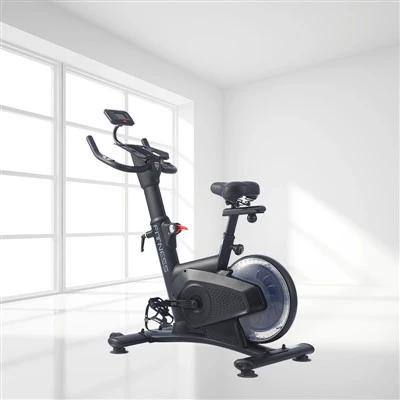
What is Stationary Exercise Bikes For Home
An exercise bike, or stationary bicycle, is an indoor workout machine that resembles and works like a normal bicycle, except it's fixed in place. Exercise bikes are one of the most widely used and popular indoor workout equipment in the world and are a staple of any good home fitness routine.
Benefits of Stationary Exercise Bikes For Home
Muscle strength and tone
Cycling will strengthen and tone your leg muscles. The primary muscles worked on a gym bike are the quadriceps (front of the thighs), glutes (bottom), hamstrings (back of the thighs), calves (back of the leg below the knee) and hip flexors (bottom of the stomach). You can also add low-weight dumbbells to a cycling workout to ensure you tone your upper body too.
Weight loss
Buying an exercise bike for weight loss can be extremely effective. The number of calories burned will depend on your age, gender and workout intensity. However, the most important factor for weight loss with an exercise bike is consistency. We recommend you think about a cushioned saddle, your cycling comfort, and the position of the bike. Can you listen to music, watch TV or follow our online workouts to keep you motivated?
Cardiovascular fitness
Cycling is an effective and simple form of cardiovascular exercise. Cardio training on a static bike can help you prepare for marathons or just help you deal better with daily demands. A healthy cardiovascular system increases the supply of oxygen to your blood and the supply of energy to your body. It helps reduce your risk of stroke and disease and can lower blood pressure.
Improve your sport
The controlled environment that a home exercise bike offers can help you to stick to a training programme without the British weather getting in the way.
Low impact exercise
The low-impact nature of exercise bikes makes them a good option if you want to lessen any risk of injury or strain. Their smooth motion and low-impact action combine to make a workout that is easy on your muscles and joints.

The lightweight stationary bike offers a compact design for easy movement and quiet operation for a comfortable exercise experience.

The stage cycling bike is an advanced indoor fitness device designed to simulate outdoor cycling.

The flywheel stationary bike, with its 30 lbs flywheel and heavy-duty steel frame, guarantees stability while cycling. The belt-driven system provides a smoother and quieter ride than chain transport. It won't disturb your sleeping kids or apartment neighbors.

Many indoor workout bikes are equipped with displays that can display information such as riding speed, distance, calories burned in real time, helping users better monitor their workout results.

Indoor Bike with Magnetic Resistance
Indoor bike with magnetic resistance is one of the important equipment for modern home fitness, providing a convenient and efficient way for people who pursue a healthy life. I'd like to show you the detailed information about this indoor reluctance exercise bike, especially its appearance, all-inclusive design, and bright color advantages.

In the gym equipment market, magnetically driven exercise bikes attracted customer because of their unique driving methods and excellent exercise experience. We want to introduce you a magnetically driven exercise bike with a rear-drive magnetron flywheel, which not only has a stylish appearance and a girly pink color, but also has a transparent all-inclusive design to make your fitness journey more enjoyable and efficient.

Stationary Exercise Bikes for Home
As a popular choice for modern home fitness, home stationary exercise bikes have been favored by more and more fitness enthusiasts due to their convenience, efficiency and small footprint. It not only meets the needs of daily exercise, but also helps users achieve a variety of fitness goals such as fat loss, body building, and muscle gain.
Why Choose Us
Product Or Service Advantages
Our products or services may be of higher quality, richer in functionality, better in performance, or more in line with customer needs. These advantages can make our products or services stand out in the market and attract more customers.
Cost Advantage
We achieve lower costs through effective cost control, supply chain management or production efficiency optimization, so that we are able to offer more competitive prices. This allows us to capture a larger share of the market and attract more price-sensitive customers.
Customer Experience Advantage
We may pay more attention to customer experience and provide better pre-sale, in-sale and after-sales services. This advantage can increase customer satisfaction and loyalty, promote repeat purchases and word-of-mouth communication.
Innovation Advantage
We may have a stronger sense of innovation and ability, and can continuously introduce new products or services to meet the changing market demand. This advantage allows us to stay ahead of the curve and attract more customers who are looking for innovation.
What are the Different Types of Stationary Bikes
Upright Exercise Bike
An upright exercise bike is very similar to a traditional outdoor bicycle. An upright exercise bike has handlebars in front and an upright seating position.
Recumbent Bike
A recumbent bike has a reclining seat position along with back support. This support for the back reduces lower back and joint strain. A recumbent bike is also lower to the ground, making it easier to get on and off.
Indoor Cycling Bike (Spin Bike)
Indoor cycling bikes are also known as spin bikes. They are designed for fast-pedaling and to increase the number of calories burned. They have a built-in resistance knob that allows users to alter resistance. The seats and handlebars are easily adjusted to fit a person's stature.
Dual-Action Stationary Bike
A dual-action stationary bike combines lower and upper body workouts thanks to the moving handlebars. With moving handlebars as well as pedals, a dual-action bike works out the user's leg muscles along with their arm and shoulder muscles.
Air Bike (Fan Bike)
An air bike is a cross between a traditional exercise bike and an elliptical. Air bikes use air resistance generated by a fan or flywheel to provide resistance. As you pedal faster, the resistance increases.
Ergometer (ERG) Bike
An ergometer bike (ERG) is designed to measure the amount of work a user does by pedalling the bike. These bikes are commonly used by professional athletes and sports trainers because they allow the user to assess performance and track progress.
Lower Body
As you pedal for the first few minutes, you will begin to feel the strain on your legs. But which muscles are feeling the benefit of the workout?
Quads and Hamstrings
These are your front and back thigh muscles and they continually work as you pedal. Your quads can be found in your femur bone and act as knee extensors. A stationary bike targets this muscle group by having the quads steadily working as you pedal.
The hamstrings on the other hand are the upper thigh muscles that work opposing the quadriceps. Its purpose is to flex the knee and allow it to bend as you pedal. As you pedal, the hamstrings are worked and toned depending on the intensity.
Glutes
The gluteal muscles, also known as your butt, are worked whenever you push down when pedaling. These muscles help in propelling you forward by working with the hip to pivot your thighs as you cycle. Cycling tones and strengthens your small, medium, and large buttocks.
Calves
Your triceps sural, or calf muscles, are the muscles located at the back of your leg which do the pushing and pulling as you cycle. Cycling targets your primary calf muscle, called the gastrocnemius, as it is used to lift your heel and extend your foot during pedaling.
Hip Flexors
This is the muscle group that surrounds and supports the ball-and-socket joint in your legs. This muscle group allows you move your leg and knee up to your torso, but it' s also used to bend your upper body forwards, towards your hip. This area is worked as your body cycles, runs, or walks. Cycling allows you to work out your flexors in tandem with your hips and glutes, and has the effect of both toning and stretching them.
Upper Body
Most people are pretty familiar with how an exercise bike targets the muscles of your lower body, but it may come as a surprise to learn that cycling can also target your upper body' s muscles as well.
Riding an exercise bike won' t always work out your arms, but when you pedal with high resistance while standing above the saddle, you put pressure on your arm muscles and your lower back, giving them some serious exercise!
Finally, your back and abs feel the burn especially when you increase your cycling intensity.
As you change positions while cycling, the shift in body positioning puts pressure on your upper body' s muscle groups, helping to tone and strengthen all of your upper body muscles in your arms, back, and shoulder.
Abdominal Muscles
Aside from your legs, what other muscles does the bike machine work out? If you' ve ever had a vigorous cycling session, you' re probably aware that that cycling can and will target your ab muscles, giving them a tremendous workout.
While cycling doesn' t typically provide enough movement for you to get rock-hard abs from just cycling alone, you will develop a stronger core, which is key to helping provide a strong foundation for your body to perform the cycling motion, providing strength all throughout your body, from your hips down to your ankles.
Back
Cycling also targets your back muscles and tones and strengthens them. As your abs and back muscles improve, your spine gets increased stability, resulting in a more comfortable and steadier ride.
Biceps and Triceps
Your biceps and triceps can be found in the front and back of your arms and these muscles are worked heavily since they' re crucial for helping you grip the handlebars as you cycle.
As you intensify your cycling and ride up out of the saddle, you will target this muscle group any time that you tighten your grip.
Differences Between Exercise Bikes and Spin Bikes
There are a few main differences between exercise bikes and spin bikes to be aware of, which will help you make a decision between the two.
Purpose
Exercise bikes are designed for users of all kinds, whether beginners looking for a light workout or more seasoned cardio experts looking to get their hearts pumping.
Although they are designed for everyone, their highly adjustable nature and more comfortable design makes them beginner-friendly.
Spin bikes are designed for high-intensity cycling, and are usually used by group cycling classes.
These lean forward and have a minimal design, with the aim being to mimic riding a real road bike. These bikes are made for challenging workouts and usually aren' t very beginner-friendly.
Appearance & Design
A big difference is that regular exercise bikes usually have large pedals, an oversized seat, have you seated upright with a relatively straight back, and usually have handlebars that allow for multiple grip positions.
They often have large consoles built into the bike with a variety of extra features such as tablet holders so you can watch your favourite show as you exercise.
They can be quite large and heavy, plus they usually have a large magnetic flywheel to provide smooth and constant resistance.
Whereas spin bikes are much more minimalistic in nature, as they often have small seats and pedals, like a real road bike, and often feature the ability for riders to use specialised cycling shoes.
A spin bike has you leaning forward, in true race mode as a result the console tends to be quite basic only showing the essential workout data.
A spin bike will have a flywheel mounted at the front which uses either friction or magnetic resistance.
Adjustability and Comfort
Regular exercise bikes generally have an adjustable seat, handlebars, and many different resistance levels, which makes them versatile and beginner-friendly.
Spin bikes usually aren' t nearly as adjustable, although they are designed to replicate a real road bike riding experience.
The biggest difference in terms of comfort is the seat, if you aren't used to using a spin bike, then the seat may feel quite uncomfortable at first. Especially if you don't have the spin bike set up correctly for you.
The Type of Workout
Exercise bikes are usually used by people working out on their own. They can be used for exercise sessions of all intensity levels, although the experience is usually a bit more relaxed.
Spin bikes are most often used in high-intensity group cycling classes. Spin bikes are made for those looking for a serious workout.
Cost
Spin bikes are quite expensive due to their high-end designs, but a good regular exercise bike can be just as expensive. The difference is that you can find lower-end exercise bikes at much lower prices than starter spin bikes.
How to Pick an Exercise Bike
Maybe you want a connected bike with apps that help add the camaraderie and energy of a group cycling class to the riding experience through on-demand sessions with a variety of themes and levels. Maybe you don' t want to spend more money on the steep cost of a connected bike. If that' s the case, look for a less expensive conventional indoor bike.
Our experts prefer bikes that allow you to make small, varied height adjustments rather than those that restrict you to specific, pre-established increments. The range of these adjustments can be important, too, especially for people who are very tall, very short, or those who have mobility concerns. (Experts tell us that seat height settings more than an inch apart can be too large a difference to account for all preferences.) If you can, try out the exercise bike in person before buying it, even if you end up buying it online.
Whether or not your bike is connected and has a video screen, a good display will show some combination of your heart rate, calories burned, speed, revolutions per minute (RPM, or ''cadence,'' in biking vernacular), and details such as time and distance.
It' s particularly important for the display to show the bike' s resistance level. Some displays don' t, which means that the only indication you have of resistance is the position of the manual knob on the bike. This makes it difficult or impossible to replicate workouts if you' re trying to track your progress over time.
Look for a bike that doesn' t create a lot of extra noise during operation, which can be distracting.
Decide which extra features are important to you-including water bottle holders, dumbbells and dumbbell holders, and a heart rate monitor. If you want to be able to use the bike while reading or watching something, be sure it has a reading shelf to hold a book, tablet, or smartphone.
Capacity is the weight the manufacturer claims the bike can support. You' ll want one that can hold your body weight without a problem.
Look for a warranty that provides lifetime coverage for the bike' s frame, at least two to three years of coverage for major moving parts, and a year for labor. The poorest warranties in our tests offer just a year for the frame and as little as six months on parts and labor.
Exercise bikes have many moving parts and can be hazardous, so follow directions. When it's in use, make sure children are kept away. When it' s out of use, make sure it' s locked (if possible) and out of a child' s reach.
Exercise Bike Maintenance and Precautions
Frame: After each exercise, use a dry cloth to dry the sweat on the frame to make the bike more durable (be careful not to wipe it with a damp cloth to avoid rusting).
Flywheel: Wipe the flywheel frequently to keep it clean for more comfortable riding. After the flywheel has been used for a period of time, lubricating oil should be added to the bearing for maintenance to make the flywheel run more smoothly, reduce noise and prolong its service life.
Chain: The chain of the exercise bike should be checked regularly to check whether the chain and gears are tightly engaged, and whether the chain is offset. If there is a problem, it needs to be adjusted in time. After the bike has been used for a period of time, it should be lubricated for maintenance to prevent rust, improve exercise efficiency and reduce noise, so that the bike can run more smoothly. The chain is one of the core components of an exercise bike, and regular maintenance can prolong the life of the bike.
Belts: Check the belts for cracks and breakages and out of position for timely adjustment or replacement of the belts. The belt-type exercise bike sometimes attaches some rubber crumbs dropped by the belt in the groove of the belt, so the groove should be cleaned regularly to prevent the belt from running smoothly and causing the belt to jump out of the groove. The belt is one of the core components of the exercise bike, and regular maintenance can prolong the life of the exercise bike.
Screws: Due to long-term use, the bike will loosen the screws, so it is necessary to regularly check whether the screws in various parts of the body are loose or fall off, and whether the adjustment knobs are loose, and should be tightened or replaced in time.
Crank: If the crank is used for a long time, it is necessary to check whether the crank screw is loose, so as to strengthen it in time.
Pedal: Due to the frequent movement of the pedal, it is necessary to check whether the screw between the pedal and the crank is loose, and it should be reinforced in time. The protective foot cover should be checked regularly for aging so that it can be replaced in time.
Dial: Keep the dial clean and tidy, and replace the battery in time to prevent the battery from oxidizing and damaging the dial.
Cushion: Keep the cushion clean and dry.
Our Factory
Jiangxi Hengbu Fitness Equipment Co., Ltd., established in 2007 (formerly known as Yongkang Hengbu Fitness Equipment Co., Ltd.), is a high-tech enterprise focusing on the research, development, production, sales, and service of fitness equipment.
The company is located in Shangrao, Jiangxi, Since its establishment, the company has always adhered to the principles of integrity-based, strength-first, wholeheartedly for the customer management principle, continuous innovation, persistent pursuit, and a research and development team composed of industrial designers, structural designers, artists, etc. We have mature management, technology, warehousing, and delivery systems.


FAQ
Hot Tags: stationary exercise bikes for home, China stationary exercise bikes for home manufacturers, suppliers, factory, indoor stationary bikes for home for home workouts for those who want to work on full body strength balance coordination flexibility endurance and post workout recovery, stationary bikes for home-based workouts, home stationary cardio bikes, stationary bikes for home aerobic exercise, indoor stationary exercise bikes for home, home fitness bikes stationary
Product parameter
| Name: | 305 family spinning bike |
| Watches: | heart rate, time, speed, calories, mileage |
| Belt pulley: | New material ABS belt pulley |
| Belt: | PJ thickened silent belt |
| Handrail: | steel pipe + super NBR material can not be torn heart rate armrest |
| Seat cushion: | Spring-breathable and comfortable seat cushion |
| Crank: | Thickened threaded forging electrophoresis crank |
| Pedal: | PP material plastic pedal |
| Chain box: | new environmentally friendly PP material half-wrapped chain cover |
| Resistance bar: | Increase chrome stepless variable speed adjustment |
| Pipe thickness: | 1.5 thick Q235 pipe 80*40*1.5 flat round pipe |
| Rollers: | super wear-resistant/smooth/easy to move |
| Flywheel: | High precision dynamic balance cast iron Donkey Kong flywheel (6-10kg can be customized) |
| Flywheel diameter: | 42cm |
| Stability: | Classic triangular ultra-stable model/robot seamless welding/armrest no shaking |
| Maximum load: | 150kg |
| N.W./G.W.: | 23kg/26kg |
| Product size: | 115*50*106cm |
| Suitable height segment: | 1.5-2m |
| Packing size: | 106*21*79cm |
| Loading quantity 40HQ: | 390 units |